I've worn many hats: zoologist, photographer, engineer, daddy, grampa, grumpy curmudgeon.
I knew I wanted to photograph wildlife from an early age and to that end I pursued formal training in Zoology and photography. Despite early success (Audubon magazine inside front cover, September 1974), life circumstances and the allure of a regular paycheck led me to a few decades as an engineer in the electric utility industry. Now with an engineer's regular pension, I'm free to pursue life wearing some of the other hats.
I live in a semi-rural part of Sacramento County California. The coast is two hours west, the crest of the Sierra Nevada is two hours east, the fabulous wildlife refuges of the Sacramento Valley are two hours north. There might be a trend here.
Wildlife photographs don't have to be two hours away, or a continent away. In fifteen minutes I can be in the floodplain of a river with otters, beavers, herons and a seasonal salmon run that attracts eagles and Osprey. A messy semi-wild oak woodland and a bubbly fountain attract migrating songbirds to my back yard.
Travel to new locations has its own rewards but I find many of the best photographs are close to home where I can visit often, get to know the individual animals and study them through the seasons, and find the optimum light and backgrounds for the photographs that best portray the creatures.
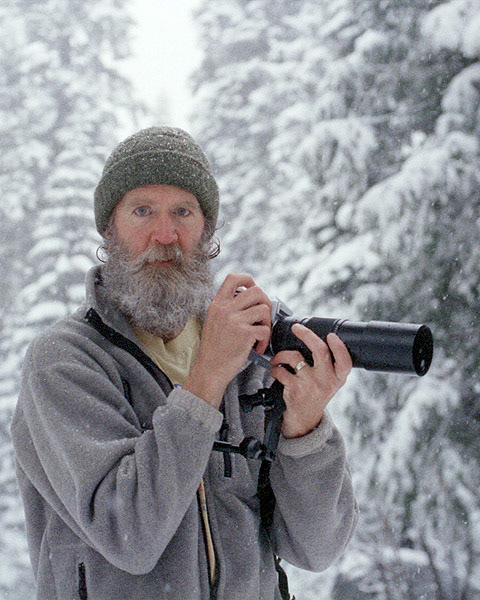
when my beard had some color
the photographs
This is where the artist's statement is supposed to go. Spoiler: I'm not a fan of flowery artist's statements, the ones that include words like "evoke", "transcend", "sublime" and the like. I'm not going to tell you how you should feel about my photographs. You look, you decide.
What I will tell you is that there are three broad ranges of photos presented here:
1) photographs suitable for a field guide. They show you what the critter looks like. Maybe even show something of its habits or habitat.
2) pretty photographs. Some are suitable for hanging on the walls. A few even make it onto my favorites pages.
3) photographs suitable for testing your skill at identifying a bird from a really crummy picture. You'll find these scattered within the photographic Life List pages.
My goal when photographing wildlife is do no harm, form a connection with the animal and use the camera to share the connection with the audience (that's you). A few of these connections have evaded my camera:
the Collared Pika who shared a rock perch with me after sniffing my pants
the American Mink that ran across my feet
the Red Crossbill that landed on my head
the Gyrfalcon that hopped too close for my lens to focus.
Other equally memorable moments were recorded by my camera like the Black-tailed Jackrabbit who ran toward me for safety, the Green Herons who determined that I was a benign part of the background scenery, a Red Fox who sat for a portrait.
That's my statement, now go look at the photographs.
all rights reserved
last updated 23 December 2025